
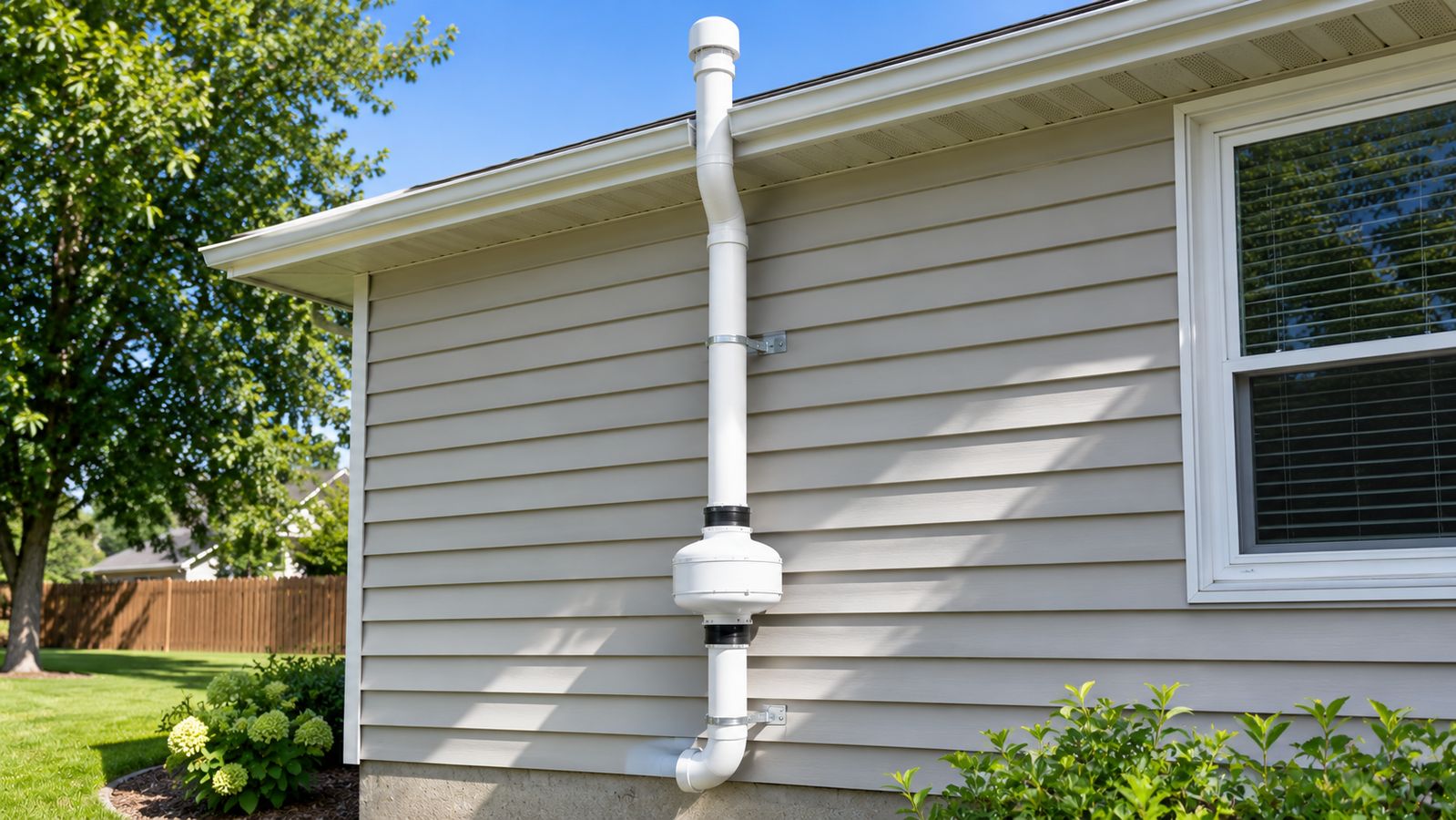
When a Grand Island home needs radon mitigation
The U.S. EPA recommends fixing a home when a radon test shows 4.0 pCi/L or more, and suggests considering it between 2 and 4 pCi/L. If your first test was a short one, a follow-up test is a sensible step before you spend money, unless you are in the middle of a home sale and time is short.
The most common system: sub-slab depressurization
Most Grand Island homes sit on a basement or a concrete slab, and for those the standard fix is called active sub-slab depressurization. In plain terms:
- A hole is cored through the basement floor or slab and a small pit is cleared under it.
- A PVC pipe is sealed into that hole and routed outside or up through the house.
- A fan on the pipe runs continuously, drawing soil gas from under the floor before it can enter the house.
- The pipe releases that air above the roofline, where it thins out harmlessly.
- Cracks, sump lids and other openings are sealed so the fan works efficiently.
- A simple gauge on the pipe shows the fan is pulling, and a follow-up test confirms the new radon level.
Our page on how a radon mitigation system works goes through each part.
Crawl spaces, sump pits and other foundations
- Crawl spaces: a heavy plastic sheet is sealed over the soil and the fan draws from beneath it.
- Sump pits: the sump can sometimes double as the suction point, with a sealed lid that still lets the pump work.
- Mixed foundations: homes with a basement plus a slab or crawl space may need more than one suction point.
What to expect on installation day
Most single-family installs take a few hours to one day. There is some drilling noise and a little dust at the suction point. The fan is usually placed outside or in an attic, never in living space or a basement. Afterwards the system uses about as much electricity as a light bulb left on, and the fan should run all the time.
Questions to ask a radon provider in Nebraska
- Are you licensed by the State of Nebraska for radon mitigation? (The Nebraska DHHS Radon Program publishes the list.)
- Where will the pipe and fan go, and what will it look like from the street?
- Is the follow-up test included in the price?
- What warranty comes with the fan and the workmanship?
Grand Island Radon is a referral service, not a radon contractor. We do not perform testing or mitigation. Enquiries are passed to an independent local provider licensed by the State of Nebraska, who sets their own prices and terms.